End-to-End Verification
This page is the honest answer to "does Echidna actually work end to end?" Android capture-path interception is a very hard, device-specific problem, and Echidna is likely not to work on many phones even when every artifact builds, installs, and launches correctly. The matrix below separates what was really built, run, and measured on this build host, stock emulator, and rooted emulators from what still needs release-device validation: full Magisk/LSPosed install, physical-device SELinux behavior, and supported capture-route coverage. Audio HAL and AudioFlinger are explicitly unsupported boundaries rather than unverified routes.
Reading guide. Every row in the "Verified" table below corresponds to a real build, test run, or on-device action with recorded output. The "Still not verified" section lists exactly what was not run here, and why, followed by a step-by-step procedure to reproduce it on release hardware.
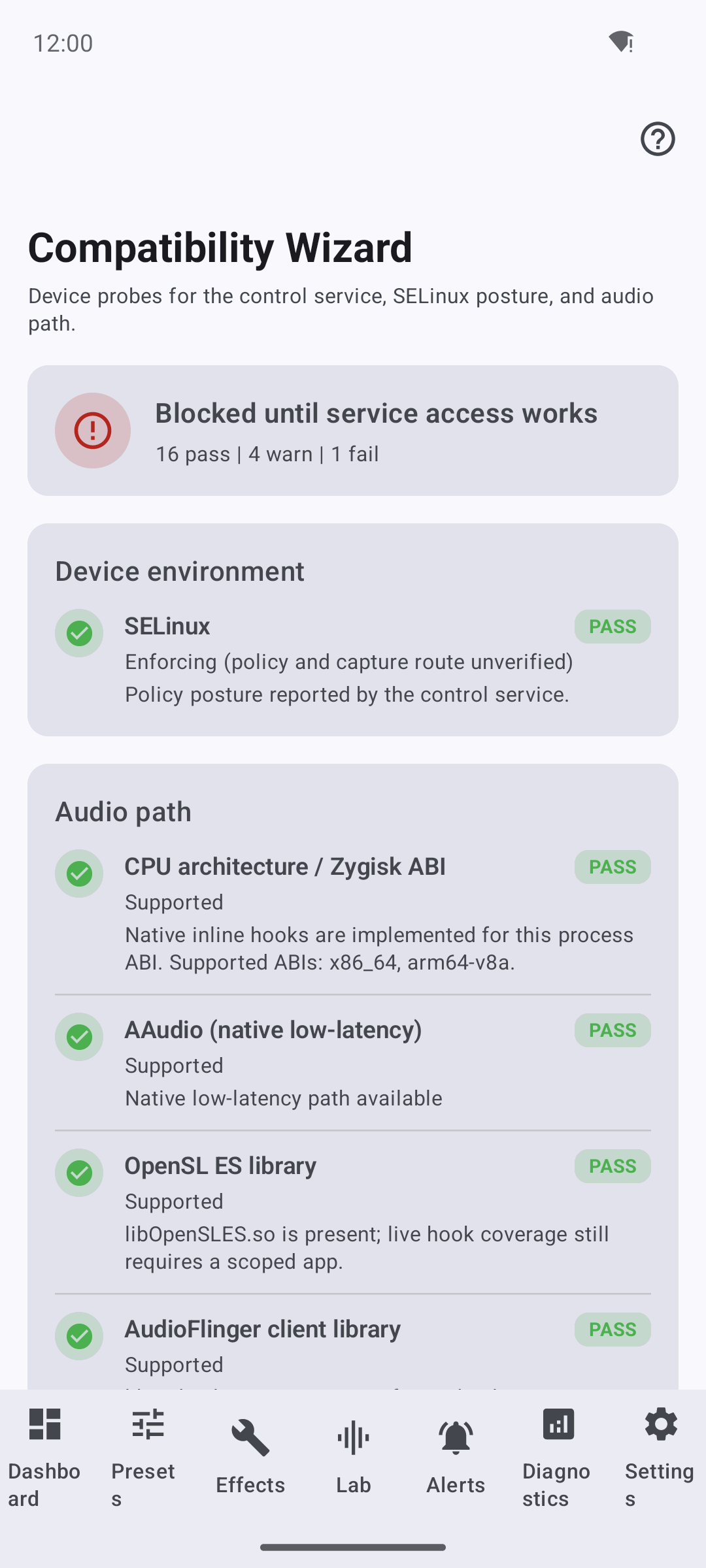
echidna_e2e emulator the Compatibility Wizard reports the engine path blocked
(no root / service access). Everything in the "Verified" table was reached from this build;
everything in "Still not verified" needs the rooted hardware inverse of this screen.Verification host: Windows 11, PowerShell + Bash. Toolchain: Android SDK C:\android-sdk,
NDK r27 (27.0.12077973), JBR OpenJDK 21, Gradle 8.5 (wrapper), CMake 4.2.1 / Ninja 1.13.2,
apksigner (build-tools 34.0.0), Docker Desktop 4.72.0 (engine 29.4.2), stock emulator
emulator-5554 (AVD echidna_e2e, API 34 / Android 14, x86_64, unrooted), plus rooted
x86_64 AVDs echidna_e2e33 (Android 13) and echidna_m26 (Android 14) for the native
processBlock testing and the historical, pre-redesign AudioRecord.read interception probes.
1. Verified on this build host / emulator (real, reproducible)
| Check | Method | Result |
|---|---|---|
| Signed release APKs | Companion + shim assembleRelease with a disposable release key, then tools/verify_android_artifacts.py with its certificate SHA-256 |
PASS — both APK signatures verify, both match the pinned non-debug certificate, and exact package/native payload checks pass. Hosted publication now performs the same fail-closed signing preflight and verification |
| Debug APK | :app:assembleDebug plus exact payload verification |
PASS — the companion contains only libechidna_control_jni.so for four ABIs; engine/DSP/shim JNI libraries do not leak into it |
| Per-ABI native libs | NDK r27 superbuild, arch-checked with llvm-readelf -h |
PASS — four targets × three ABIs: engine, DSP, shim JNI, and libechidna_preproc.so. Release tooling transports/verifies all four families |
| Flashable Magisk zip | tools/build_magisk_module.sh + tools/verify_magisk_module.py --build-root build |
PASS — the deterministic archive has an exact 25-file regular-file layout: three Zygisk engines, three DSP libraries, three inert preprocessor libraries, signer/registration helpers, installer/watchdog files, narrow sepolicy.rule, status helper, and license. The verifier binds all nine native entries byte-for-byte to the trusted NDK outputs, checks each ELF ABI, SONAME, required export and exact DT_NEEDED set, enforces Unix modes and duplicate-free entries/policy, rejects generated SPKI/HMAC material, and checks the read-only trust-input label lifecycle and default-off activation contract |
| Docker native-build → magisk pipeline | docker compose build native-build then run native-build, then magisk-packager |
PASS — the packager consumes engine/DSP pairs plus all three preprocessor ABIs; registration is generated only on an eligible device for its next boot |
| Host native tests | Native CTest suites | PASS — DSP, routing, v2 protocol/generation, authenticated lifecycle/reconnect, and legacy preprocessor ABI/lifecycle/audio/no-allocation tests pass |
| App unit tests | ./gradlew :app:testDebugUnitTest (Robolectric, headless) |
PASS 24/24 — preset serialize/round-trip, status/control/whitelist JSON parsing, repository CRUD |
| Service unit tests | ./gradlew :service:testDebugUnitTest (headless) |
PASS — strict v2/default/owner/control validation, persistence, panic expiry, authenticated scoped delivery, generation rules, and fail-closed defaults |
| Android instrumentation | :app:connectedDebugAndroidTest on emulator-5554 (clean install) |
PASS 12/12 — real in-APK EchidnaControlService bind + AIDL round-trips (control-state read, master, panic, whitelist write/read-back, pushProfileSnapshot/listProfiles, getModuleStatus), profile-switch flow, QS-tile state source, Compose dashboard render |
| Rooted Android app instrumentation | .\gradlew.bat :app:connectedDebugAndroidTest on echidna_e2e33 (Android 13) and echidna_m26 (Android 14) |
PASS 13/13 on both — includes the real in-APK service bind and processBlockAppliesPresetWhenNativeEngineIsAvailable, which applies a native cut preset and asserts finite, measurably attenuated output when libechidna.so/libech_dsp.so are reachable |
Historical rooted AudioRecord interception probe |
.\gradlew.bat :interception-probe:connectedDebugAndroidTest on the same rooted emulators |
PASS 1/1 on both before the current redesign — useful evidence for the older interception slice, but not proof that current native AudioRecord is reachable without its explicit PCM contract |
| App install + launch | adb install -r app-debug.apk; launch .MainActivity |
PASS — install Success, MainActivity resumed, process stays up |
| Crash-free relaunch | 8 cold relaunches (am force-stop + am start) with a persisted echidna_presets.json present, scanning logcat |
PASS 8/8 — 0 crashes, process alive every launch. This is the exact trigger of the startup crash found by instrumentation (see highlight below) |
| In-app screen navigation | adb input nav + uiautomator dump across screens |
PASS (honest) — 6 screens rendered live and navigated (Dashboard, Preset Manager, Effects Editor, Diagnostics, Settings, Compatibility Wizard) with correct module-not-active state on the unrooted emulator; the Whitelist Editor was wired into the nav graph afterward (t2-e27) and verified to render; the QS tile is a registered TileService that cannot be driven headless-unrooted (its state source is unit-verified) |
| In-app control service bind | dumpsys activity services com.echidna.app |
PASS — live ServiceRecord for EchidnaControlService with an active ConnectionRecord (BIND_AUTO_CREATE); the app binds its in-app control service at runtime |
| Format gate | clang-format --dry-run -Werror over all tracked native/android C/C++ |
PASS — 0 non-conformant of 82 files |
The final full host performance report (200 warmups, 1,200 measured calls, load 0 and 8) passed 40/40 functional checks and 592 scenarios with zero strict-deadline misses and zero safety-gate failures. Its JSON contract validation passes. These are host processing-cost results only, not Android callback, HAL, acoustic, or end-to-end call latency. See Audio pipeline performance testing.
Latest rooted-emulator recheck
On 2026-07-14, the rooted checks were rerun after adding explicit CPU/ABI and native audio-library
probes to getModuleStatus():
emulator-5560/echidna_m26(Android 14, x86_64, Magisk 26.4): PASS for:app:connectedDebugAndroidTestand:interception-probe:connectedDebugAndroidTest.emulator-5556/echidna_e2e33(Android 13, x86_64, Magisk 25.2): PASS for:interception-probe:connectedDebugAndroidTest.emulator-5562/echidna_e2e(Android 14, x86_64, Magisk 25.2): FAIL for the interception probe because no current-process hook evidence was emitted. The AVD has/data/adb/modules/echidna/zygisk/unloaded, so Magisk is not loading the module there even though module files are present.- Reinstalling
out/echidna-magisk.zipwithmagisk --install-module /sdcard/Download/echidna-magisk.zipstill returnedIncomplete Magisk installon the rooted emulator, so module-manager flashing is still not claimed as verified.
These rooted interception results predate the current route-support contract and must not be used as
current native-AudioRecord reachability proof. The compatibility checker reports CPU family,
primary ABI, Zygisk ABI, active-hook support,
vendor family, and the presence of libOpenSLES.so, libaudioclient.so, and libtinyalsa.so.
Those are device signals, not live proof that OpenSL ES or tinyalsa processed audio. Audio HAL and
AudioFlinger report unsupported_injection_boundary and are not current transform routes.
Highlight — why end-to-end testing mattered: the startup crash
The most valuable finding of this pass came only from running the app on a real emulator, not from unit tests or a clean compile. The instrumentation run surfaced a release-blocking startup crash:
- Symptom. After any preset edit persisted an
echidna_presets.json, the app crashed on the next launch. Reproduced at 7 of 14 cold launches onemulator-5554. - Root cause.
ControlStateRepository'sactivePresetcombine didlist.first { it.id == id }, which throwsNoSuchElementExceptionwhen_activePresetIdtransiently referenced an id not yet present in_presets(defaults regenerate their UUIDs each launch, so a persisted file always carried differing ids). It ran onDispatchers.Default, so the uncaught exception became a process crash. - Fix. Made the combine total (
firstOrNull { … } ?: firstOrNull() ?: first()) and reconciled the active/default ids before publishing the preset list. - Proof it is gone. Post-fix, 0 of 16 cold launches crashed on the identical planted trigger; independently re-confirmed here with 8/8 clean relaunch cycles. A signed, clean-compiling APK would still have shipped this crash — only driving the real app flow caught it.
2. Still not verified / device-gated
The rooted-emulator pass proves service-side native processBlock routing through the DSP. Its
native AudioRecord.read result predates the explicit PCM-contract redesign and does not prove
current route reachability or the whole release install path. Attempts to install the refreshed zip
with magisk --install-module /sdcard/Download/echidna-magisk.zip on the rooted emulator images
returned Incomplete Magisk install, so Magisk flashing remains unverified here.
Requested coverage, explicitly:
Current capture-route status
| Route | Code status | Live proof still required |
|---|---|---|
| AAudio | Operational candidate; metadata from stream getters | Physical-device target app |
| OpenSL ES | Operational candidate; recorder PCM descriptor and host lifecycle tests | Physical-device target app |
| tinyalsa | Operational candidate; metadata from pcm_open config |
Vendor/device target app |
| LSPosed Java AudioRecord | Operational candidate; Java getters + dedicated JNI | Live LSPosed injection under SELinux |
| Legacy input preprocessor | Packaged and next-boot registration implemented for a registered system/vendor HIDL factory PID; host fixtures prove first-OTA refusal and bounded activation rollback; default-off LSPosed attachment manager requires a signed short-lived capability | Real factory discovery, post-fs/mount ordering, magic-mount label/linker namespace, descriptor/maps/AVC, attachment/enablement under enforced SELinux, and device audio mutation |
| Controller capability SPKI | Canonical 91-byte authoritative/derived pair, root:root 0444, hash/inode checks, and dedicated read-only SELinux policy are host-verified; no generated SPKI ships |
Effect-host read access to the separately labelled SPKI and signed-capability verification under enforcing SELinux |
| Telemetry origin-proof key | Per-install root pin/derived copies plus native ECHT v2 HMAC production, LSPosed relay, and control verification are host-tested; no key bytes ship or enter logs | Effect-host SELinux read access, rotation/recovery observation, and end-to-end device proof |
| Native AudioRecord | Developer contract only (ECHIDNA_AR_*) |
A safe normal-flow metadata producer is not implemented |
| libc raw-device read | Developer contract only (ECHIDNA_LIBC_*) |
A safe normal-flow metadata producer is not implemented |
| Audio HAL | Unsupported (unsupported_injection_boundary) |
Requires a new, proven audioserver/vendor-stream design |
| AudioFlinger | Unsupported (unsupported_injection_boundary) |
Requires a new, stable transform boundary |
| Requested item | Current status | What is covered / missing |
|---|---|---|
| Live Zygisk module load + real hook install on arm64 primary | Release-device-only / NOT verified here | arm64-v8a native artifacts build and package, but no physical arm64 Magisk/Zygisk load, app-specialize, or hook-install run has been recorded. |
| LSPosed shim injection + authenticated Binder policy under SELinux | Release-device-only / NOT verified here | The shim and explicit provider build, but LSPosed install/scoping, injected-process binding, caller authentication, and transform were not run. |
| SELinux enforcement + supported capture candidates on real hardware | Release-device-only / NOT verified here | The app reports SELinux/audio-stack signals, but no enforcing physical device has proven AAudio, OpenSL, tinyalsa, or LSPosed capture processing. |
| Native AudioRecord/libc normal-flow metadata | Not implemented; developer contract only | These routes require explicit ECHIDNA_AR_* / ECHIDNA_LIBC_* sample-rate, channel, and format values that normal app specialization does not supply. |
| Audio HAL / AudioFlinger transformation | Unsupported | Both fail closed with unsupported_injection_boundary; app-process Zygisk does not own a safe audioserver/vendor-stream ABI. |
| x86_64 trampoline under real injection | Host harness verified; current release path NOT verified | The older rooted probe predates the current route contract; Magisk manager flash/reboot and arbitrary target-app injection are not claimed. |
| armv7 direct-route relocator | Host-proven; on-device execution device-gated | armeabi-v7a artifacts build and the ARM32/Thumb-2 prologue relocator is host-proven (relocation harness + libechidna.so links under NDK); the relocator fails closed per function, and no real armv7 device run has yet proved on-hardware install/execution. |
| APK install -> service bind -> live AIDL round-trip | Verified on emulator/rooted emulator | App instrumentation covers installable APK execution, in-app EchidnaControlService bind, and live AIDL round-trips; this does not prove Magisk/LSPosed hardware paths. |
Still not claimed as verified:
- Magisk Manager /
magisk --install-moduleflash + reboot — including magic-mount namespace resolution ofdlopen("libech_dsp.so")againstsystem/lib(64). - Full Zygisk lifecycle on release hardware — loading from Magisk at zygote time, specializing into arbitrary target apps, and surviving reboot/module-manager install paths.
- Supported normal-flow candidates — AAudio, OpenSL ES, tinyalsa, and LSPosed Java AudioRecord still need live device coverage. Native AudioRecord/libc are developer-contract-only; Audio HAL and AudioFlinger are unsupported.
- Live LSPosed shim injection — the shim and Binder policy consumer are implemented, but LSPosed installation, scoping, injected-process Binder policy, and SELinux access were not exercised.
- Narrow config and effect-trust SELinux policy on a real enforcing device, including separate controller-SPKI and telemetry-HMAC labels and effect-host reads.
- arm64 primary hardware and armeabi-v7a runtime behavior — arm64 still needs physical-device proof; the armv7 relocator is host-proven but its on-hardware install/execution is device-gated.
- Live authenticated policy delivery under SELinux — UID-scoped Zygisk socket frames and caller/process-scoped LSPosed Binder views build and have host/unit coverage, but simultaneous injected-app delivery still needs enforcing-device validation.
Historical enforcing-emulator blocker signal
On 2026-07-15, disposable API 33 x86_64 AVD echidna_e2e33 was observed with SELinux Enforcing and
a pre-existing Echidna Magisk snapshot reporting module v0.0.0. It was not current HEAD. Live
logcat included avc: denied { write } from Maps in untrusted_app to
echidna_telemetry_file; the same process logged echidna_profile_sync: Failed to create profile
listener. The AVD was stopped without installing rebuilt artifacts. This makes a current-artifact
enforcing-SELinux rerun release-blocking; it does not establish that the current authenticated
socket/Binder implementation fails identically.
3. Reproduce on a real device (the device-gated procedure)
Run this on a rooted physical device with Magisk 24.0+ and Zygisk enabled to exercise the release path that the rooted-emulator probe did not cover:
- Root + Magisk. Unlock the bootloader and install Magisk (patched boot image /
fastboot). Confirm the Magisk app shows installed andsuworks. - Enable Zygisk. Magisk → Settings → Zygisk ON → reboot. Zygisk is required for the
libechidnamodule to load into audio processes. - Flash the Echidna module. Build
out/echidna-magisk.zip(per-ABI, single idechidna; viatools/build_magisk_module.shor the dockermagisk-packagerimage — both verified above). Magisk → Modules → Install from storage → select the zip → reboot.customize.shplaceslibech_dsp.soper ABI intosystem/lib(64)and stageslibechidna.sofor the in-app JNIdlopenpath. Before calling the legacy effect ready, verify that the controller SPKI hasechidna_controller_spki_file, the telemetry HMAC hasechidna_telemetry_key_file, and only the expected effect-host domains read them. A successful host verifier or module install alone is not this device proof. - Install the LSPosed shim (Java fallback). Install LSPosed (Zygisk flavour), enable the Echidna module in LSPosed, and scope it to the target app(s). This drives the authenticated read-only Binder policy path when native capture is unavailable.
- Grant the per-app whitelist. In the companion app, enable the target package in the whitelist / app-binding. The system is fail-closed — unlisted processes are never hooked. Avoid scoping the same target app into both Zygisk and LSPosed unless this test is explicitly checking duplicate-hook behavior.
- Open a route-matched target app. First identify whether it records through AAudio, OpenSL,
tinyalsa, or Java
AudioRecord; then start its capture path. Do not treat HAL/AudioFlinger or an unconfigured native AudioRecord/libc manager as a valid current test target. - Verify pitch/effect live. Select a pitch/formant preset (e.g. Darth Vader or Helium), speak, and confirm the transform in the target app's monitor or sidetone. Cross-check on-device via Diagnostics: the Tuner should show a non-zero Detected Hz / offset (cents), the latency histogram should populate (no longer "No latency data yet"), the CPU heatmap should show samples. Treat installed, Zygisk availability, and fallback recommendations as capability signals only; require recent transformed-buffer telemetry for a verified route. The Compatibility Wizard should then report Magisk installed + Zygisk enabled — the inverse of the unrooted state captured on the emulator.
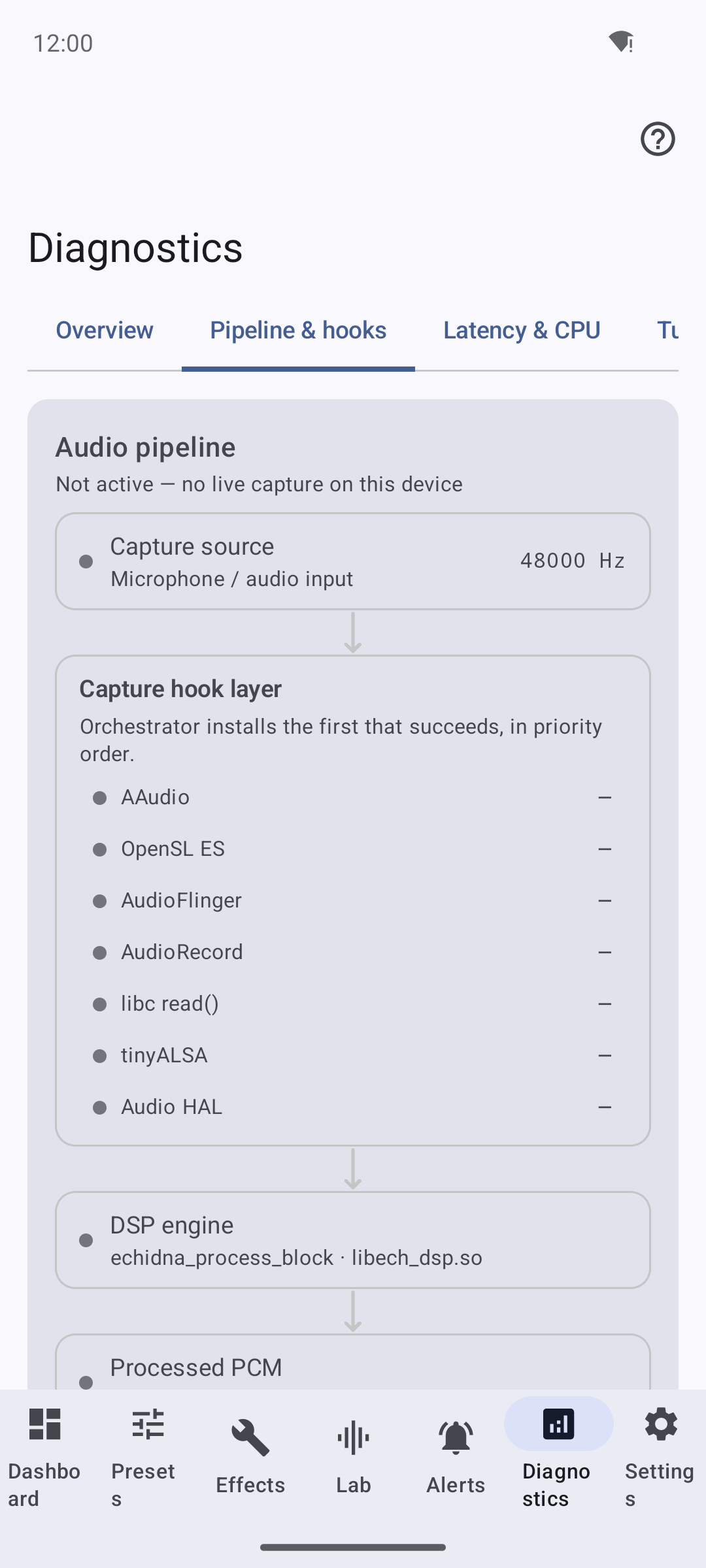
- Export diagnostics for support. In Diagnostics -> Logs & safety, enable telemetry export
and use Export diagnostic internals. The bundle is sanitized and includes action codes such
as
configure_whitelistwhen no target apps are enabled. Combine it with a static HAL analyzer report throughtools/build_hook_probe_report.pybefore filing a hook-support issue.
Sources: release-readiness gate (t2-e20), docker native → magisk container run (t3-e1b),
emulator install/launch/nav + crash-free confirmation (t3-e3), instrumentation + crash
discovery (t2-e18), crash fix + proof (t2-e26), native tests (t2-e17), rooted Android
13/14 app instrumentation, and the historical pre-redesign rooted Android 13/14 AudioRecord
interception probe.