Evidence & Observability State Model (§18)¶
Scope of this document. It defines every telemetry / evidence state Echidna can represent on the host, states precisely what each one means, maps them to the report §1 state ladder, and — following the report's prime directive (do not overstate proof) — marks exactly which states are honestly unobservable on the host and require a physical device / rooted-Zygisk emulator to witness.
The governing rule the report demands and this model enforces:
Distinct real states must never be conflated. hooked ≠ mutated; block count ≠ mutation count; route-presence ≠ route-use; a bypass is not a failure; an unchanged block is not a mutated block.
1. Where evidence lives (three layers)¶
Echidna's observable state is split across three deliberately separate mechanisms. Keeping them separate is what makes the non-conflation guarantees above representable at all.
| Layer | Type | File | Represents |
|---|---|---|---|
| Lifecycle status | latched enum | state/shared_state.h InternalStatus |
coarse per-process status: kDisabled / kWaitingForAttach / kHooked / kError |
| Admission | lock-free permit | state/shared_state.{h,cpp} audio_processing_usage_ + AudioProcessingPermit |
whether the realtime path is policy-admitted right now, with an in-flight drain refcount |
| Per-route telemetry | lock-free counters | utils/telemetry_accumulator.{h,cpp} |
route-by-route install level + processing/mutation/bypass/failure edges |
The wire exporter (runtime/telemetry_socket_exporter.cpp, owned outside this
track) derives a single state string per route from the telemetry deltas and
serializes a subset of them — see §5 and Findings.
2. Telemetry counter semantics (the authoritative definitions)¶
TelemetryAccumulator holds one cache-line-isolated Counters block per
TelemetryRoute. A take(route) returns a TelemetryDelta and atomically
drains the edge counters; the level bit is reported but not cleared.
| Field | Kind | Meaning | Drained by take()? |
|---|---|---|---|
blocks |
edge | count of blocks processed on this route (route-use) | yes |
frames |
edge | frames seen across all outcomes (wraps mod 2³²) | yes |
mutations |
edge | blocks whose output actually differed from input | yes |
bypasses |
edge | blocks admitted but deliberately not processed | yes |
failures |
edge | block-processing failures only — a block could not be processed (original audio preserved). Never inflated by a failed install. | yes |
install_events |
edge | hook install/attach transitions recorded | yes |
install_failures |
edge | hook attach/install failures — kept separate from block failures so "route never attached" ≠ "a block failed to process" |
yes |
installed |
level | current hook/install presence (route-presence) | no — latched |
| unchanged | derived | blocks − mutations − bypasses − failures |
— |
Key structural facts (locked by tests/telemetry_accumulator_test.cpp):
installedis a latched level, not an edge. Two consecutivetake()s reportinstalled == trueboth times, butinstall_eventsis non-zero only on the first. Route-presence persists; route-use drains.- An installed route with no new use is not
pending(). The level alone never triggers an export — presence does not masquerade as use. - The four block outcomes partition
blocksexactly. Every processed block incrementsblocksandframes, then bumps exactly one of {mutations,bypasses,failures} or none (unchanged). Thereforemutations + bypasses + failures + unchanged == blocksalways. - Recording is realtime-safe.
recordBlock/recordInstalluse only lock-free relaxed atomics — no allocation, no lock, no logging, no syscall. 20 000 mixed records + drains allocate zero bytes in the test. - Telemetry never stores PCM.
recordBlocktakes a frame count (uint32_t), never a sample pointer. The accumulator's footprint is a fixed64 · kCount-byte counter array; it cannot grow with traffic and structurally cannot retain audio content.
3. The four block outcomes (TelemetryBlockOutcome)¶
| Outcome | Set when | Audio effect | Not to be confused with |
|---|---|---|---|
kUnchanged |
processed, output bit-equal to input | none audible | a bypass (unchanged was still processed) |
kMutated |
processed, output ≠ input | audio actually altered | merely being hooked / installed |
kBypassed |
admitted but intentionally skipped (bypass timer / policy) | passthrough | a failure (bypass is intentional) |
kFailure |
block could not be processed; original preserved | passthrough | a mutation or a bypass |
The classification is produced at the DSP boundary (api.cpp
echidna_process_block / echidna_stream_process) by comparing output against
input (LevelStats.changed / the stream registry's mutated flag), not
inferred from the fact that a hook fired. This is the concrete mechanism behind
hooked ≠ mutated: a hook can run, process a block, and legitimately report
kUnchanged.
4. Mapping to the report §1 state ladder¶
The report's §1 ladder ascends from installed to verified. Each rung maps to a specific evidence source, and each is honestly labelled by whether it is observable on the host (unit/CTest, no device) or device-gated.
| §1 ladder rung | Meaning | Represented by | Host-observable? |
|---|---|---|---|
| installed | module artifact present on device | Magisk module + install_events/installed on first attach |
❌ device-gated (module load) |
| loaded | libechidna.so mapped into a target process |
Zygisk postAppSpecialize attach; InternalStatus leaves kDisabled |
❌ device-gated |
| policy-connected | process received controller config (whitelist/preset) | SharedState::updateConfiguration from shared memory / profile-sync |
❌ device-gated (IPC + SELinux) |
| admitted | this process is whitelisted and hooks enabled | SharedState::audioProcessingAllowed() / AudioProcessingPermit |
⚠️ logic host-testable; live admission device-gated |
| hook-installed | a capture hook trampoline is in place for a route | recordInstall(route, true) → installed level |
⚠️ recording host-testable; real trampoline device-gated |
| stream-discovered | an audio stream/callback was intercepted | blocks > 0 for the route |
❌ device-gated (needs live audio) |
| processing | blocks are flowing through the DSP | blocks > 0, exporter state = "processing" when mutations > 0 |
⚠️ mechanism host-testable; live flow device-gated |
| mutating | output actually differs from input | mutations > 0 |
⚠️ classification host-testable; live mutation device-gated |
| verified | measured transform matches intent end-to-end | no single flag — requires FFT/measurement on device | ❌ device-gated |
How to read the ⚠️ rows. The ability to represent and record the state is
proven host-side (the counters exist, are independent, and behave correctly —
locked by the test). What is not provable host-side is that the state was
actually reached against real Android audio: that a real AAudio callback fired,
that a real trampoline was installed, that a real app's stream was discovered.
Those require a device and are covered by docs/verification.md /
docs/hardening/rt-safety.md and the t4 on-device logs — not by this track.
The same ladder as a diagram — green rungs are witnessable in host CTest, amber rungs have host-testable mechanism but device-gated reality, red rungs need a physical device / rooted-Zygisk to observe at all:
flowchart TD
    A[installed<br/><small>module artifact on device</small>]:::dev
    B[loaded<br/><small>libechidna.so mapped in target</small>]:::dev
    C[policy-connected<br/><small>config/whitelist received</small>]:::dev
    D[admitted<br/><small>whitelisted + hooks enabled</small>]:::mixed
    E[hook-installed<br/><small>trampoline in place</small>]:::mixed
    F[stream-discovered<br/><small>callback intercepted</small>]:::dev
    G[processing<br/><small>blocks flowing through DSP</small>]:::mixed
    H[mutating<br/><small>output ≠ input</small>]:::mixed
    I[verified<br/><small>measured transform = intent</small>]:::dev
    A --> B --> C --> D --> E --> F --> G --> H --> I

    classDef host fill:#1b5e20,stroke:#2e7d32,color:#fff;
    classDef mixed fill:#e65100,stroke:#ef6c00,color:#fff;
    classDef dev fill:#7f1d1d,stroke:#b71c1c,color:#fff;
Amber (admitted, hook-installed, processing, mutating): the counters and
classification exist and are host-tested; the live event they represent is
device-gated. Red (installed, loaded, policy-connected,
stream-discovered, verified): unobservable without a device. No rung is
painted green here because even the host-representable rungs still require a real
Android process to be reached — the honest reading of §6.
5. What the wire actually carries¶
telemetry_socket_exporter.cpp collapses a route's delta to one state string:
mutations != 0 -> "processing"
bypasses  != 0 -> "bypassed"
failures  != 0 -> "error"
otherwise      -> "installed"
Since the schema-v3 evolution (t8-e2), EncodeTelemetry serializes the full
non-conflation set, not just the four v2 fields:
| Wire location | Fields | Since |
|---|---|---|
deltas (edges) |
blocks, frames, failures, mutations |
v2 |
deltas (edges) |
bypasses, installEvents, installFailures |
v3 |
root (level) |
installed |
v3 |
v3 is a strict superset of v2: no v2 key was renamed or dropped, three delta
edges and the latched install level were added, and schemaVersion is 3. The
state precedence above is unchanged. This closes the wire-layer gap that finding
F2 (below) reported: a bypass is not a failure / not an unchanged block and
route-presence ≠ route-use are now representable on the wire, not only in
the accumulator. The controller's strict validator was not weakened to allow
this — see §7-F2 for how the schema bump kept the exact-key-set check intact.
6. Honestly unobservable on the host (device-gated)¶
These cannot be witnessed by any host unit test and must not be claimed as "done" from CTest alone:
- Real module install / load / specialization into an Android process
(Zygisk
postAppSpecialize). Host tests exercise the accumulator, not the Android loader. - Real hook trampoline installation for any capture route (AAudio, OpenSL,
AudioFlinger, AudioRecord, libc
read, tinyalsa).recordInstallrecording is host-tested; the actual inline-hook success is device/ABI-gated. - Stream discovery / live block flow — requires a real app producing audio;
blocks > 0is only meaningful on-device. - End-to-end "verified" transform (e.g. the −7-semitone pitch measurement)
requires on-device capture + FFT; see t4 logs and
docs/verification.md. - Policy propagation under enforcing SELinux to hooked apps.
The in-app Diagnostics screen makes this honesty visible rather than faking activity. On an unrooted device with no native engine, every telemetry-derived value rests at its empty state — there is nothing to accumulate:
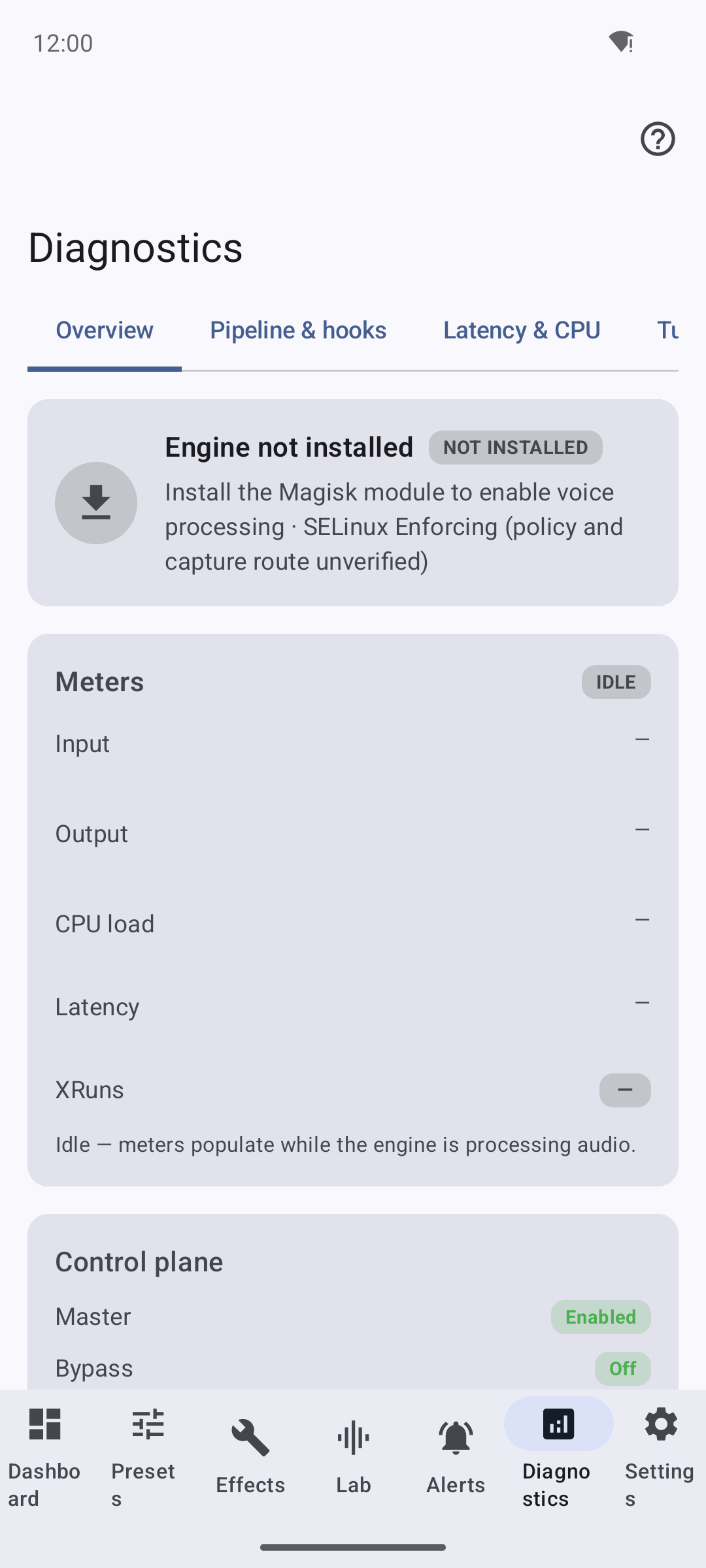
Honest by design: Engine Not Installed, XRuns 0, metrics at −120 dBFS, "No latency data yet". None of the ⚠️/❌ rungs in §4 have been reached, so the counters are legitimately zero — the surface reports absence, not a fabricated "processing" state.
7. Findings¶
This track (t6-e4) reported both findings below rather than applying wire-visible changes itself. F1 was subsequently landed by t6-e8; F2 was landed by t8-e2 (schema-v3). Both are now closed.
F1 — install failure was folded into the block failures counter — LANDED (t6-e8) ✅¶
Original finding: TelemetryAccumulator::recordInstall(route, /*success=*/false)
incremented the same failures counter used for audio-block processing
failures, so a consumer (and the exporter's StateFor → "error") could not
distinguish "the route failed to install" from "a block failed to process."
Resolution (landed). t6-e8 added a dedicated install_failures edge counter
to Counters / TelemetryDelta (telemetry_accumulator.{h,cpp}).
recordInstall(false) now increments only install_failures; the block
failures counter is never inflated by a failed install. install_failures is
a proper edge — drained by take(), summed by merge(), reset by clear(),
and included in pending(). Install-failure and block-failure are now
independently observable, so the last residual conflation inside the accumulator
is closed. tests/telemetry_accumulator_test.cpp Section D was rewritten to lock
the separated semantics (a failed install bumps install_failures, leaves
block failures at zero, and does not latch installed).
F2 — exporter dropped bypasses / installed / install_events at the wire — LANDED (t8-e2) ✅¶
Original finding: the v2 EncodeTelemetryV2 serialized only
{blocks, frames, failures, mutations}, and StateFor returned the literal
"installed" as a fallback without reading the installed bool. Consequences:
- downstream could not separate bypassed from unchanged (bypasses absent
from the wire), weakening a bypass is not a failure / not an unchanged block
at the wire layer;
- the latched install level never reached the controller, so
route-presence was invisible off-device except as the fallback string.
The obstacle was correctly identified as a security constraint, not a bug to
paper over: the controller's AuthenticatedTelemetry.kt runs a strict
exact-key-set validator (a §13 hardening control) that rejects every frame
carrying an unexpected key. Appending fields to the v2 frame would have made the
validator reject all telemetry. Widening the field set therefore required a
coordinated, validator-aware schema bump, not a loosened check.
Resolution (landed). t8-e2 landed schema-v3 as a strict superset of v2
(see §5): native EncodeTelemetry emits v3 (deltas gains bypasses /
installEvents / installFailures; root gains installed; schemaVersion 3).
AuthenticatedTelemetry.kt now accepts both v2 and v3, each validated against
its own strict key-set — the schemaVersion range widened to 2..3, and
unknown/mixed keys are still rejected, with peer-cred, published-identity, and
seq/gen anti-replay untouched. The fields thread through frame/store/baseJson
and the app-side Diagnostics surface reads them (TelemetryParser.kt,
AdvancedDiagnosticsSection.kt). The strict validator was not weakened.
Verified by GATE-3 (telemetry_socket_exporter_test asserting the v3 key set,
AuthenticatedTelemetryTest unknown-key / mixed-key / replay / schemaVersion
-bound cases, app AuthenticatedTelemetryParsingTest). See
checklist §18-F2
and threat-model §3.2.
Note — local CRLF on state/shared_state.{h,cpp}¶
The working-tree copies carry CRLF from core.autocrlf=true; the committed
blobs are LF and clang-format-18 clean, so CI/GATE-1 (LF) are unaffected. No
change made.
8. Test coverage map (tests/telemetry_accumulator_test.cpp)¶
| Section | Locks |
|---|---|
| A | four outcomes independent; unchanged is the exact derived remainder; block count ≠ mutation |
| B | hooked ≠ mutated both directions (install ⇏ block; mutation ⇏ install) |
| C | installed level persists across take(); edges drain; presence ≠ pending |
| D | install-failure signals: !installed, one install event, install_failures bumped, block failures untouched (F1 separated semantics, landed t6-e8) |
| E | per-route isolation (no cross-contamination) |
| F | realtime safety: zero allocation under load, lock-free, fixed PCM-free footprint |
| G | merge() coalescing: level last-wins, event edges summed |