Magisk Module Packaging & Release
⚠️ Manual recovery knowledge required
Echidna is experimental root software and may be incompatible with the device you are using. Do not flash the Echidna Magisk/Zygisk module unless you already know how to disable a module manually from recovery, adb, safe mode, or another out-of-band rescue path if the phone bootloops. If you cannot recover from a bad module without the normal Android UI, do not install this module.
Echidna ships its on-device engine as a single flashable Magisk/Zygisk module (module id
echidna). tools/build_magisk_module.sh consumes the per-ABI NDK output and produces a real,
flashable zip. This aligns with the deployment flow in
spec.md.
Requirement. Magisk 24.0+ with Zygisk enabled, on Android 8.0 (API 26) or newer. The module enforces this:
module.propdeclaresminMagisk=24000, andcustomize.shhard-aborts on a Magisk version code below 24000 or an unsupported CPU architecture (only 32-bit x86 is unsupported — the module ships arm64-v8a, armeabi-v7a, x86_64).Status. Packaging is host-verified (layout,
bash -n, script correctness, and Android ELF contents). Rooted Android 13/14 emulators prove the nativeprocessBlockpath. A nativeAudioRecord.readinterception slice passed before the current explicit-contract route redesign and is historical evidence only. Actual Magisk flashing remains unverified here:magisk --install-module /sdcard/Download/echidna-magisk.zipreturnedIncomplete Magisk installon the emulator images. Treat Magisk Manager install, reboot, LSPosed injection, current capture routes, and SELinux behavior as device validation.
Failsafe and recovery contract
⚠️ Echidna's module must be treated as boot-sensitive. A release should never assume the normal Android UI will remain available after flashing. Users and release testers must know how to disable the module before installing it.
Intended disable paths:
- Magisk module disable file: create Magisk's disable marker for the
echidnamodule, normally/data/adb/modules/echidna/disable, from recovery or adb when/datais mounted. - Echidna runtime disable marker: create
/data/adb/echidna/disableto keep Echidna inactive even if the module files remain installed. - Safe-mode path: use the project's safe-mode path when available so Echidna starts disabled and the companion app can report the reason instead of activating hooks.
- Early recovery markers: create
/cache/echidna-disableor/metadata/echidna-disablewhen/datais unavailable, encrypted, or unsafe to modify from recovery. - Automatic boot watchdog: the watchdog is intended to disable Echidna after repeated boots that do not reach the late-start service. It is a last-resort guard, not a replacement for manual recovery knowledge.
- Trust re-enrolment: inspect
/data/adb/echidna/trust/status.txt. For an intentional companion signer or capability-key replacement, disable the module first, remove the pending/active pin only while disabled, reinstall the trusted app/module pair, then reboot. Never replace a pin under a live audio service.
For a step-by-step recovery ladder once a device is already bootlooping — safe-mode/all-modules-off
boot, the disable markers above, a fastboot flash of a stock boot.img (removes Magisk), and a
clean Magisk reinstall — see Recovering from a bootloop.
You don't have to flash by hand — there's a guided in-app installer
Manual flashing (below) is the authoritative path, but the companion app now ships a guided
installer that detects Magisk/Zygisk, installs the module (from a bundled echidna-magisk.zip
when the build ships one, otherwise a picked .zip), does the unload-first disable, and
prompts the reboot needed to load a live Zygisk module. The last mile — the actual Magisk flash
— is still device-gated (it needs real root; magisk --install-module returned Incomplete
Magisk install on the emulator). Walkthrough: Installer guide.
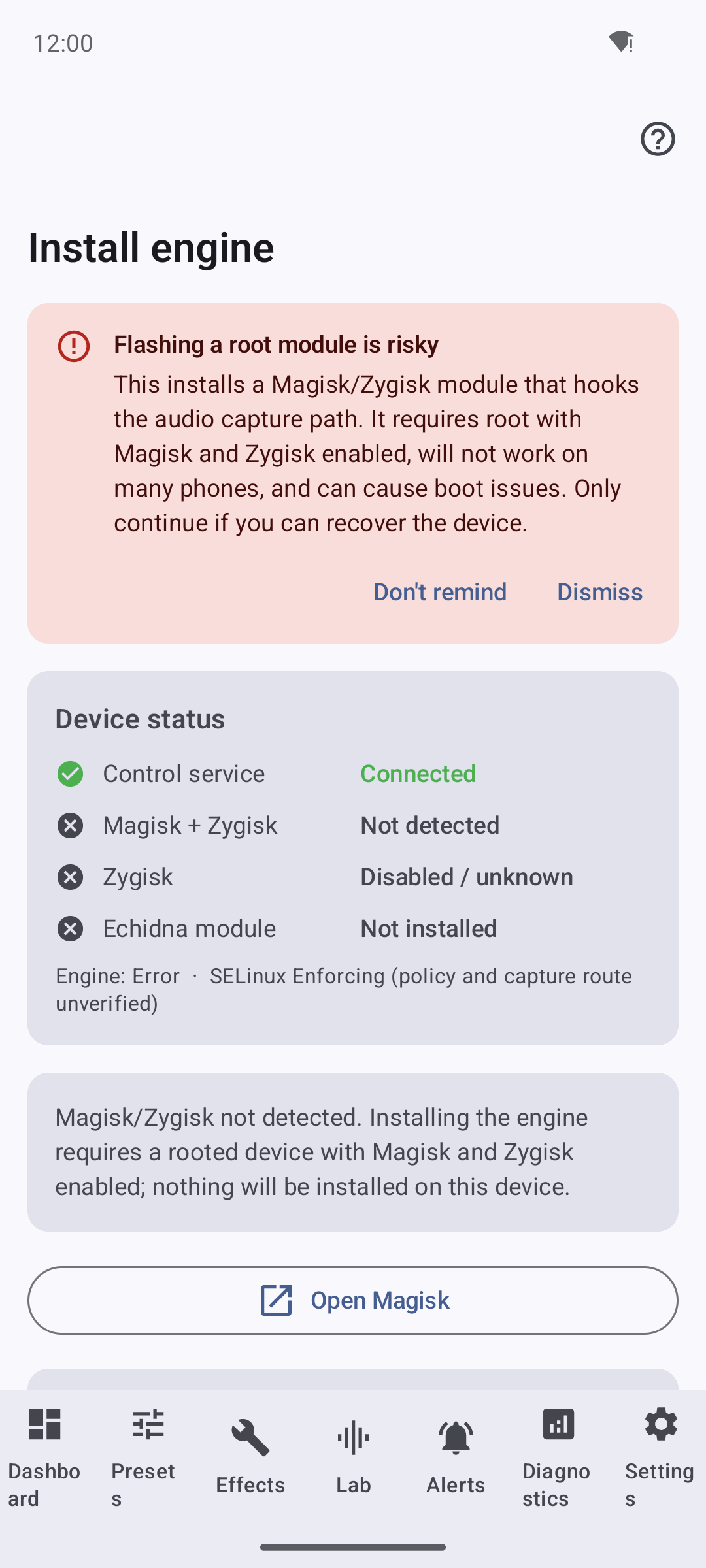
The install path should be loud about compatibility before reboot. Hard requirements should abort the install where they are known locally, while device-compatibility signals should alert without pretending to prove success. The checks to surface include:
- Android API and Magisk version.
- Zygisk availability and whether the user has enabled it.
- Primary CPU ABI, supported ABI list, unsupported
x86, and native-hook support for the selected ABI. - Presence of the matching Zygisk payload and
libech_dsp.sofor the selected ABI. - Incomplete install or bridge state, including missing
/data/adb/echidnaruntime directories, missing JNI search-path libraries, or stale shared telemetry/config files. - SELinux enforcing state and whether the narrow config/telemetry policy steps succeeded.
- Vendor audio family and common native audio libraries (
libOpenSLES.so,libaudioclient.so,libtinyalsa.so) used only as compatibility signals. Their presence does not prove capture. - Existing audio/root modules that are known or suspected to conflict.
- Duplicate Zygisk plus LSPosed scope for the same target app.
These checks are alerts and guards. They do not make Echidna safe for ordinary Android users, and they do not remove the user's responsibility for having a bootloop recovery path.
What changed from the old packaging
- Single module id. The previous split — a trivial
id=echidnamodule plus a separateid=echidna-controlmodule underandroid/control-service/magisk/— is unified into oneid=echidnamodule. The control-service runtime-policy/watchdog scripts (post-fs-data.sh,service.sh) are reused into that single module; the oldechidna-controlmodule.propis removed. - Per-ABI Zygisk payload. The engine ships as
zygisk/<abi>.so(Zygisk's required naming), one per ABI, instead of a single host-archzygisk/libechidna.so. - Real per-ABI Android libraries. The libs come from the NDK cross-compile, not host ELFs.
- Flashable installer. The zip now carries
META-INF/com/google/android/update-binary+updater-scriptand acustomize.sh, so it installs via Magisk Manager or recovery.
Inputs
The native superbuild produces four libraries for each of three ABIs. The Magisk packager consumes
engine/DSP pairs plus inert preprocessor staging, while libechidna_shim_jni.so is reserved for the
LSPosed APK. Preprocessor registration remains default-off and device-generated:
build/<abi>/lib/libechidna.so   → zygisk/<abi>.so      (Zygisk engine, per ABI)
build/<abi>/lib/libech_dsp.so   → libs/<abi>/...        (staged; placed by customize.sh)
build/<abi>/lib/libechidna_shim_jni.so                 (LSPosed APK input; not in module)
build/<abi>/lib/libechidna_preproc.so → preproc/<abi>/  (inert next-boot source)
Build those first (see developer_readme.md):
sh
ANDROID_NDK=/path/to/android-ndk ANDROID_PLATFORM=android-26 \
  bash tools/build_native_ndk.sh
The script fails loudly if any required per-ABI libechidna.so / libech_dsp.so is missing.
Zip layout
zygisk/arm64-v8a.so             # libechidna.so per ABI (Magisk loads the one matching each process)
zygisk/armeabi-v7a.so
zygisk/x86_64.so
libs/<abi>/libech_dsp.so        # staged DSP libs; customize.sh places the right arch into system/lib(64)
lib/libechidna.so               # (populated at install) primary-ABI engine for the in-app JNI
META-INF/com/google/android/update-binary
META-INF/com/google/android/updater-script
customize.sh                    # install-time ABI mapping + placement
module.prop                     # id=echidna, version templated at package time
post-fs-data.sh                 # watchdog + region creation, labels, and narrow policy
service.sh                      # watchdog clear + runtime library staging
common/zygisk-status.sh         # shared, read-only Zygisk state probe
common/echidna-trust-helper.jar # module-owned app_process Dex helper (classes.dex)
common/release-cert-sha256      # normalized exact companion release signer pin
common/trust-mode               # production, or an explicit non-production development marker
common/trust-bootstrap.sh       # late signer/UID/dataDir/SPKI verifier and next-boot pinning
common/telemetry-key-label.sh   # exact effect-key label/hash/inode fail-closed lifecycle
sepolicy.rule                   # narrow region and effect-key types/grants
At install, customize.sh maps Magisk's $ARCH to the build ABI, copies the matching
libs/<abi>/libech_dsp.so onto the linker search path (system/lib64 on 64-bit, system/lib on
32-bit, plus the 32-bit companion DSP on 64-bit devices), stages libechidna.so into $MODPATH/lib
for the in-app control-service JNI (dlopen from /data/adb/modules/echidna/lib), removes the
libs/ staging, and sets permissions.
Runtime bootstrap (narrow policy + shared runtime files)
post-fs-data.sharms the boot watchdog, creates/data/adb/echidna/{lib,run}, mirrorslibechidna.soto the JNI search path, and prepares/data/local/tmp/echidna(plugin directory plus pre-sized config/telemetry region files). It applies dedicated region types and narrow app read/write grants matchingsepolicy.rule. Before module-file exposure it also verifies and labels any existing effect HMAC backing inode. A failure removes that derived copy and engages the module failsafe. It does not grant zygote transitions or binder access.service.shmarks late-start as reached, clears the watchdog, removes transient effect-config backing left after Magisk's mount phase, recreates safe runtime permissions, stageslibechidna.so, and invokes trust then inert effect staging nonfatally. Failure leaves the legacy preprocessor unregistered or identity-bypassed; it never blocks boot, widens SELinux, replaces a live key, or restarts audioserver.
The helper supports API 26–34 only. It verifies the current PackageManager signer, user-0
UID/dataDir, and app-owned P-256 SPKI before staging a root-owned read-only copy under
trust/next-boot/. After effect eligibility and the registry merge succeed, the registration helper
copies the same verified key to the module overlay for
/system/etc/echidna/preprocessor_controller_p256.spki; both registry and key are next-boot inputs.
After those package and SPKI checks, the same helper generates one per-install 32-byte telemetry
HMAC key when and only when no prior root/app/effect copy exists. The authoritative root:root 0400
pin and SHA-256/key-ID-only metadata live under trust/state/. Atomic derived copies are app-owned
0600 at ${dataDir}/files/echidna/preprocessor_telemetry_hmac.key and root:audio 0440 at the
module backing for /system/etc/echidna/preprocessor_telemetry_hmac.key. Regular-file drift is
restored only from the root pin; symlinks, root metadata drift, or a missing root pin with surviving
derived copies fail closed. Effect backing is replaced by atomic rename after the mount phase, so
it is a next-boot update and does not hot-replace a currently mounted/loaded inode. Before trust
bootstrap reports success, common/telemetry-key-label.sh verifies the root-pin hash, 32-byte size,
root:audio 0440 ownership, stable inode, and exact
u:object_r:echidna_telemetry_key_file:s0 context. Early post-fs-data repeats that check before
Magisk exposes the next-boot copy. Only audioserver and the standard hal_audio_server attribute
receive { getattr open read }; no app, broad system/vendor file type, write, map, or execute grant
is added.
Default-off legacy effect registration
common/effect-registration.sh does not use the SDK level as an eligibility shortcut. It requires
registered-service PID evidence from lshal list -ip for a legacy HIDL
IEffectsFactory/default. It rejects Stable-AIDL-only factories, HIDL+AIDL discovery, and multiple
registered factory PIDs. The selected PID is tied to a stable /proc/<pid>/stat start time, a
verified /proc/<pid>/exe target and executable map, and matching ELF class/machine. This supports
generic and vendor-cohosted audio-service names without trusting process command-line text. Android
14 is eligible when it still registers that legacy HIDL factory. A Stable-AIDL-only Android 14
device is not.
The config search follows the platform order: ODM, API 30+ vendor-SKU, vendor, then system XML;
legacy vendor/system .conf is used only when no XML is readable. An active ODM config is rejected
without falling through because Magisk documents vendor overlays through system/vendor but no
equivalent supported ODM module path. The selected system/vendor source is merged semantically:
- the exact
echidna_preproclibrary and implementation UUID are inserted once; - the type UUID remains library-descriptor evidence, as required by the legacy effect ABI;
- every existing vendor registry/processing entry is retained;
- malformed, duplicate, conflicting, or ambiguous input is rejected;
- processing instructions, CDATA, entity references, and other unsupported DOM nodes are rejected instead of being silently dropped;
- no XML
preprocessor legacypre_processingapplication is created.
The module-owned Dex helper validates root ownership/no-follow reads, strict UTF-8, ELF class and
machine, the AELI marker, and P-256 SPKI. It atomically stages the generated registry outside the
auto-mounted tree under registration/next-boot/config/, plus the matching lib(64)/soundfx
library and exact system key, before committing state-v2 metadata. Metadata records
source/overlay/library/key SHA-256 values, exact inert/transient paths, source path, format,
partition, ABI/bitness, build fingerprint, both UUIDs, and auto_apply=false. Repeated staging must
match every tracked output.
Magisk documents module post-fs-data.sh as blocking and running before module files are mounted.
Echidna uses that ordering as the activation boundary: it first removes all stale or interrupted
config backing, then validates current fingerprint, stock source hash, metadata ownership/mode, and
the config/library/key paths and hashes. Only a fully verified registry is copied to the exact
transient system/system/vendor module path for Magisk's subsequent mount. Any mismatch or copy
failure removes both partial and transient files, so the stock config remains active for that boot.
The late service removes the transient backing after the mount phase and may prepare only inert
state for another boot. A mounted library or key is inert without registry registration. Fingerprint,
source, or tracked-output drift creates registration/restage-required; it does not disable the
whole module, and early activation remains off until an explicit reinstall/restage. Legacy v1 state
also requires restaging.
The release ZIP itself contains no generated active or inert audio_effects.xml/
audio_effects.conf, controller SPKI, telemetry HMAC key, or telemetry key metadata.
tools/verify_magisk_module.py --zip out/echidna-magisk.zip --build-root build checks the exact
25-member, duplicate-free Unix regular-file layout and binds all nine native members byte-for-byte
to the trusted NDK outputs. It verifies the Zygisk engine, DSP, and preprocessor ELF ABI, SONAME,
required exports, exact DT_NEEDED sets, and archive modes. It also checks duplicate-free ordered
policy, early activation ordering, exact registration constants, and the absence of command-line
host discovery, auto-apply, or hot audioserver restart tokens. The external build root is the
provenance authority; archive-contained metadata cannot authorize replacement native payloads.
This is still device-gated. The repository has not yet proved a real device's active HIDL host and config, post-fs/mount ordering, magic-mount file labels/linker namespace, factory descriptor, process maps, or AVC-free load. Host fixtures cover activation rollback and first-OTA refusal. Registration alone never attaches or enables the effect; only the separate default-off LSPosed session manager can request authorized attachment, and no device audio transformation is proved. Telemetry-key provisioning alone does not prove live native-origin authentication. Native ECHT v2 HMAC production, LSPosed relay, and control-service verification are implemented and host-tested; effect-host key reads under enforced SELinux and end-to-end device proof remain device-only gates.
Native Zygisk policy is owned by the companion service's authenticated abstract AF_UNIX socket
echidna_profiles; LSPosed uses the companion's read-only Binder provider. There is no filesystem
policy socket endpoint for module scripts to create.
See developer_readme.md.
Script usage
From the repo root, after the native build, build the Dex helper and provide the normalized signer pin:
```sh bash tools/build_trust_helper.sh RELEASE_CERT_SHA256=<64-hex-release-cert-digest> tools/build_magisk_module.sh
→ out/echidna-magisk.zip
```
Environment overrides:
ECHIDNA_ABIS(defaultarm64-v8a armeabi-v7a x86_64)ECHIDNA_VERSION(default0.0.0) /ECHIDNA_VERSION_CODE(default: digits of version, else 1)ECHIDNA_BUILD_ROOT(default<repo>/build),ECHIDNA_OUT_DIR,ECHIDNA_ZIP_PATHRELEASE_CERT_SHA256(required exact companion signer pin)ECHIDNA_TRUST_HELPER_JAR(defaultbuild/trust-helper/echidna-trust-helper.jar)ECHIDNA_TRUST_MODE(productionby default; explicitdevelopmentis not releasable)
The echidna/magisk-packager docker image runs this step in a pinned environment (see
developer_readme.md).
GitHub release workflow
.github/workflows/ci.yml calls .github/workflows/release.yml after the normal CI gates pass on
each push to main. The release workflow scans existing release tags, creates the next YY.N tag
on the pushed commit, builds the release assets, and publishes a GitHub Release. Pushed release tags
and manual workflow_dispatch releases remain supported. Release tags use YY.N format, such as
26.1 and 26.2 in 2026.
Each GitHub Release now gets a part-by-part asset set:
| Asset | Contents |
|---|---|
echidna-companion-<tag>.apk |
Companion app plus in-process control service. |
echidna-lsposed-shim-<tag>.apk |
Installable LSPosed/Xposed Java fallback shim. |
echidna-magisk-<tag>.zip |
Flashable Magisk/Zygisk module. |
echidna-native-libs-<tag>.zip |
Raw engine, DSP, and dedicated shim JNI library for every ABI. |
echidna-apks-<tag>.zip |
Companion APK and LSPosed shim APK together. |
echidna-complete-<tag>.zip |
All release assets above plus RELEASE_ARTIFACTS.md. |
SHA256SUMS.txt |
SHA-256 checksums for all published release files. |
RELEASE_ARTIFACTS.md |
Short install/asset manifest generated by the release job. |
Use the newest GitHub Release for normal installs. Do not flash an earlier release unless you are intentionally rolling back or already understand the recovery procedure for a broken Magisk/Zygisk module. Older release zips may contain boot or module bugs that newer releases fixed, so recovery can be harder than with the current build.
Manual dispatch behavior:
- Leave
tagempty to compute the next tag for the current UTC year by scanning existing tags. - Provide an explicit tag only when it matches
YY.N; invalid tags such asv26.1,2026.1,26.0, or26.01are rejected before build jobs start. - Existing tags can be released manually only when no GitHub Release already exists for that tag.
- Every release entry point requires a complete keystore, private-key alias/password, and expected certificate SHA-256. Missing, partial, malformed, or mismatched signing inputs fail before publication; hosted releases never publish Gradle's local debug-signing fallback.
Automatic push behavior:
- Every accepted push to
mainbecomes a release candidate and publishes only after the normal CI gates plus the native, Magisk, and Android release jobs complete. - Unconfigured signing is skipped, not failed. When every release signing secret is absent
(the common fork/mainline case), automatic publishing is skipped so normal mainline CI stays
green. Strict failures are preserved for partial, invalid, manual, and tag-triggered releases:
a half-configured keystore, a mismatched certificate pin, or any explicit tag/
workflow_dispatchrelease still fails loudly rather than silently publishing a debug-signed or unsigned artifact (tools/check_release_signing.py; commitfix(release): skip unconfigured automatic publishing). - The auto tag is created from the latest existing tag in the current UTC year. For example, if
26.3is the latest 2026 release tag, the nextmainpush publishes26.4. - Auto-tagging is serialized by workflow concurrency so consecutive pushes compute tags in order.
Release checklist
- Cross-compile the per-ABI native libs (
tools/build_native_ndk.sh) for the full ABI list. - Run the native/DSP tests and hook smoke checks.
- Package the module with
tools/build_magisk_module.sh(setECHIDNA_VERSION). - Build the release-signed companion and LSPosed APKs (
assembleReleasewith a real keystore — see signing.md). - Verify signer continuity. A previously debug-signed APK cannot be upgraded in place to a release certificate; back up needed data and perform a one-time uninstall when migrating signers.
- On a rooted device (Magisk 24.0+): enable Zygisk, flash
out/echidna-magisk.zip, reboot, install the companion app, and validate supported capture candidates plus SELinux behavior via the compatibility wizard and diagnostics view. Audio HAL/AudioFlinger remain unsupported. - Avoid scoping the same target app into both Zygisk and LSPosed unless the release test is explicitly validating duplicate-hook behavior.