Limitations
Echidna intercepts the microphone/capture path inside other apps' processes on Android. That is powerful, and it is also intrinsically constrained by things Echidna does not control: how each vendor builds their OS, how each SoC routes audio, and the security model of modern Android. This page is a candid inventory of those constraints. None of them is a bug to be "fixed" in a release; they are properties of the platform Echidna operates in. Read them before flashing anything.
Status context
Everything below reflects the design and the code as it stands. Where a limitation is
device-gated — only observable on rooted hardware or release hardware — it is marked
as such. The project has rooted-emulator proof for native processBlock. An
AudioRecord.read interception slice passed before the current explicit-contract redesign
and is historical evidence only. Magisk flashing, live LSPosed injection, supported capture
routes, and physical-device SELinux behavior remain open (see
Verification).
⚠️ User responsibility
Echidna is experimental and provided as-is for rooted-device power users. It may be incompatible with the phone you are using. If you flash it on the wrong device, combine incompatible install paths, lose recovery access, or brick the phone while experimenting, recovery is your responsibility. The project does not warranty safe operation on any specific device.
⚠️ Recovery knowledge is a prerequisite
If you do not already know how to disable a Magisk/Zygisk module from recovery, adb, safe mode, or another out-of-band path after a bootloop, do not install Echidna. The existence of failsafe markers does not guarantee that your recovery environment can mount or edit the needed partitions.
Install-risk failsafes are guardrails, not guarantees
Echidna's intended failsafes are designed to help a prepared user boot again if the module causes trouble. They are not a promise that every device can be recovered through the same path.
The documented disable markers are:
- Magisk's module disable file for
echidna, normally/data/adb/modules/echidna/disable. - Echidna's own runtime disable marker at
/data/adb/echidna/disable. - The project's safe-mode path, when available.
- Early recovery markers at
/cache/echidna-disableand/metadata/echidna-disable. - An automatic boot watchdog intended to disable Echidna after repeated boots that do not reach the late-start service.
These paths can fail to help if recovery cannot decrypt /data, the bootloader is locked, adb is
unavailable, /cache or /metadata is absent or inaccessible, another module breaks earlier in
boot, or the device has vendor-specific recovery behavior. Treat every install as experimental and
device-specific.
If the device has already stopped booting, see Recovering from a bootloop for a
least-invasive-first recovery ladder (all-modules-off boot → disable markers → fastboot flash of a
stock boot.img → clean Magisk reinstall).
1. Root is required — there is no rootless mode
Echidna hooks the capture path inside the target app's process. Android gives normal apps no way to do this. That means:
- A working Zygisk implementation is mandatory for full coverage — it loads the native
libechidna.somodule into audio processes, and it is the only path that reaches the native capture APIs. The documented install path remains Magisk + built-in Zygisk; standalone Zygisk providers can be detected by the compatibility probe, but APatch/KernelSU/Zygisk Next combinations remain device-gated until validated on the target hardware. - LSPosed + the Echidna shim is a narrower alternative, not a drop-in replacement. It
needs root too (LSPosed itself does), and it is subject to two hard constraints:
- It hooks
android.media.AudioRecordonly. Apps that capture through AAudio, OpenSL ES, or Oboe are not covered by the shim in any configuration. No scope, whitelist, or setting changes this — those paths exist only in the native Zygisk module. - It is inert unless the companion names it capture owner, which it does only
while DSP engine mode is Compatibility (Settings → Engine → DSP engine mode).
Under the default
Native firstmode the shim installs and LSPosed reports it as loaded and active while it transforms nothing. Diagnostics → Pipeline → Advanced diagnostics → Capture ownership shows the effective owner, andlogcatcarries the shim's per-process verdict ([NOT_CAPTURE_OWNER],[NOT_WHITELISTED], and so on).
- It hooks
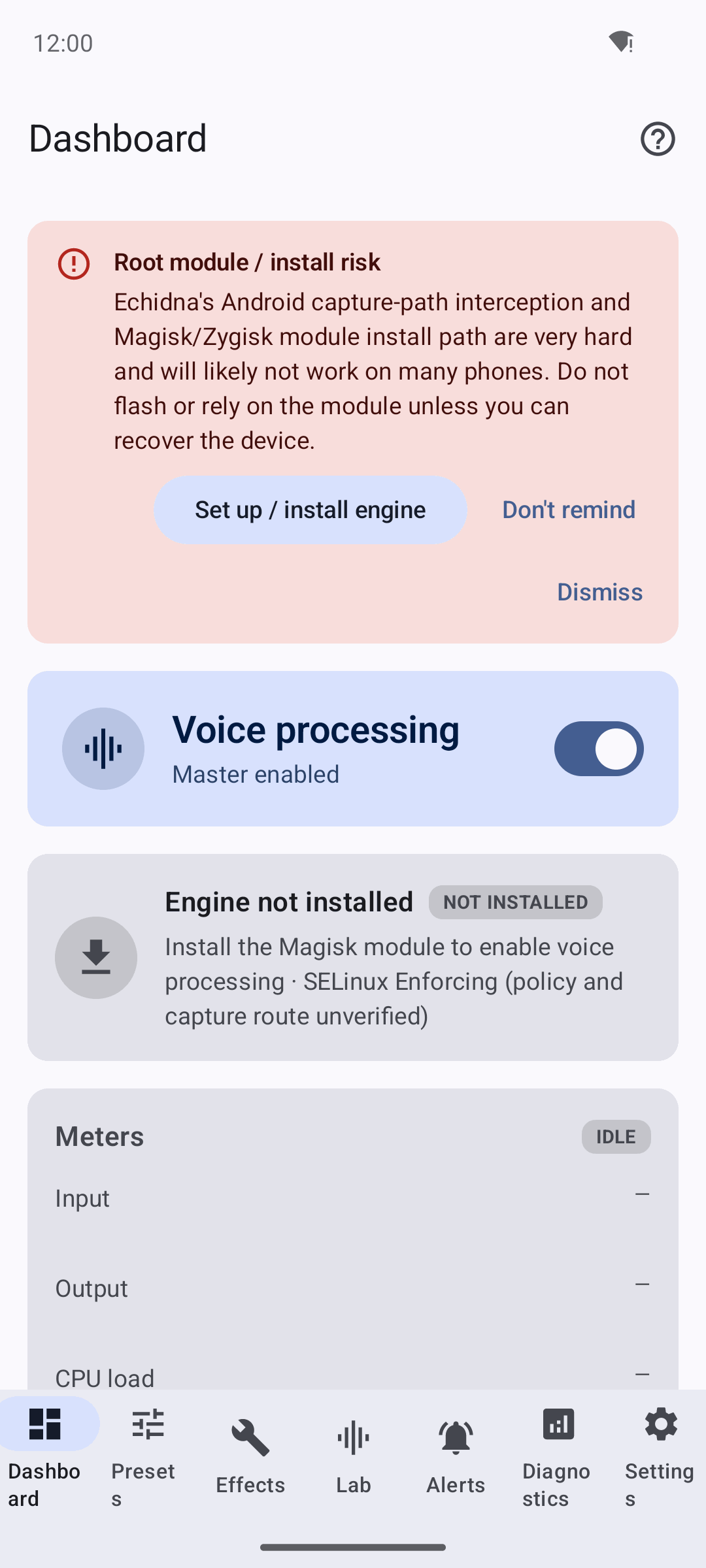
- On an unrooted device the companion app still runs — you can browse presets, configure the effect chain, and run the Compatibility Wizard — but the engine stays "Not Installed" and no audio is transformed. This is exactly what the app reports on an unrooted emulator today: Native: Not Installed, SELinux: Enforcing (Java-only fallback).
- Rooting carries real risk (bootloader unlock wipes data; some devices lose banking/DRM attestation). That is a decision only you can make for your device.
There is no plan for a rootless mode, because the capability Echidna needs (intercepting another app's microphone capture) is precisely what Android's sandbox is designed to prevent.
2. Not distributed through an app store
Echidna is delivered as a sideloaded companion APK plus a flashable Magisk/Zygisk zip. It will not appear on Google Play or, in its rooting form, on F-Droid. You install the APK manually and flash the module in Magisk. There is no auto-update channel; you update by re-flashing/re-installing. This is a direct consequence of item 1.
3. OEM and SELinux variance
Modern Android runs SELinux in enforcing mode, and every vendor ships different policy. Echidna's native module, abstract profile-sync socket, shared telemetry/config files, and DSP library placement touch operations that a vendor's policy may or may not allow to the contexts Zygisk-injected code runs in.
- The Magisk module defines dedicated config and telemetry file types. It grants app domains read-only access to config, read/write access to telemetry, and only the parent-directory traversal needed to reach those files. It does not grant zygote transitions or binder access. A vendor may still deny a required operation outside this narrow policy.
- Some strict-policy devices may only allow the weaker Java-only (LSPosed) fallback, not the full native hook path. Diagnostics may recommend that path; a recommendation is not evidence that LSPosed injection or transformed-buffer processing is active.
- A disposable enforcing API 33 x86_64 emulator observed on 2026-07-15 had an old installed Echidna
module v0.0.0, not current HEAD. Maps (
untrusted_app) loggedavc: denied { write }toechidna_telemetry_fileand thenFailed to create profile listener. This is historical live evidence that rebuilt current artifacts need an enforcing-SELinux rerun, not proof that the current authenticated transports fail the same way. - Device-gated: the exact policy needed on any given phone can only be determined on that phone. This has not been validated on hardware here.
4. Capture-route coverage across SoCs and vendors
There is no single "the microphone" on Android. Which API an app uses and how it routes to the vendor audio stack differs by app and chipset. Echidna therefore exposes a support matrix instead of claiming that every manager is operational:
| Route | Current status |
|---|---|
| AAudio | Operational candidate; stable stream getters provide PCM metadata. |
| OpenSL ES | Operational candidate; recorder sink provides the PCM descriptor. |
| tinyalsa | Operational candidate; pcm_open config provides metadata. |
LSPosed Java AudioRecord |
Operational candidate through Java getters and dedicated JNI. |
| Legacy input preprocessor | Packaged and conditionally registered for next boot; default-off authorized LSPosed attachment candidate with no device audio proof. |
| Telemetry HMAC key | Per-install provisioning plus native ECHT v2 production, LSPosed relay, and control verification are implemented and host-tested; effect-host SELinux reads and end-to-end origin proof remain device-gated. |
Native AudioRecord |
Developer contract only (ECHIDNA_AR_SR/CH/FORMAT). |
| libc raw-device read | Developer contract only (ECHIDNA_LIBC_SR/CH/FORMAT). |
| Audio HAL | Unsupported (unsupported_injection_boundary). |
| AudioFlinger | Unsupported (unsupported_injection_boundary). |
- Echidna attempts every eligible normal-flow candidate because an app may touch multiple APIs (see Architecture). “Operational candidate” is code reachability, not device proof.
- The native rows are ABI-qualified. On
armeabi-v7a, the direct inline-symbol routes (AAudio, OpenSL ES, tinyalsa, nativeAudioRecord, libc-read) are now backed by a host-proven ARM32/Thumb-2 prologue relocator; on-device install/execution is device-gated (see item 6). LSPosed Java/JNI and the legacy input preprocessor remain eligible under their separate policy and device gates. - Even so, some apps or devices route audio through a path Echidna does not yet hook, or through a vendor-specific HAL variation, in which case that app's capture is not transformed (and, being fail-closed, is left untouched rather than corrupted).
- Native
AudioRecordand libc reads stay disabled during normal specialization because no safe producer supplies their explicit PCM contracts. Audio HAL and AudioFlinger live across an audioserver/vendor boundary that app-process Zygisk does not own; they fail closed instead of attempting private offsets or unstable object layouts. - The Compatibility Wizard reports CPU family, primary ABI, Zygisk ABI, vendor family, and
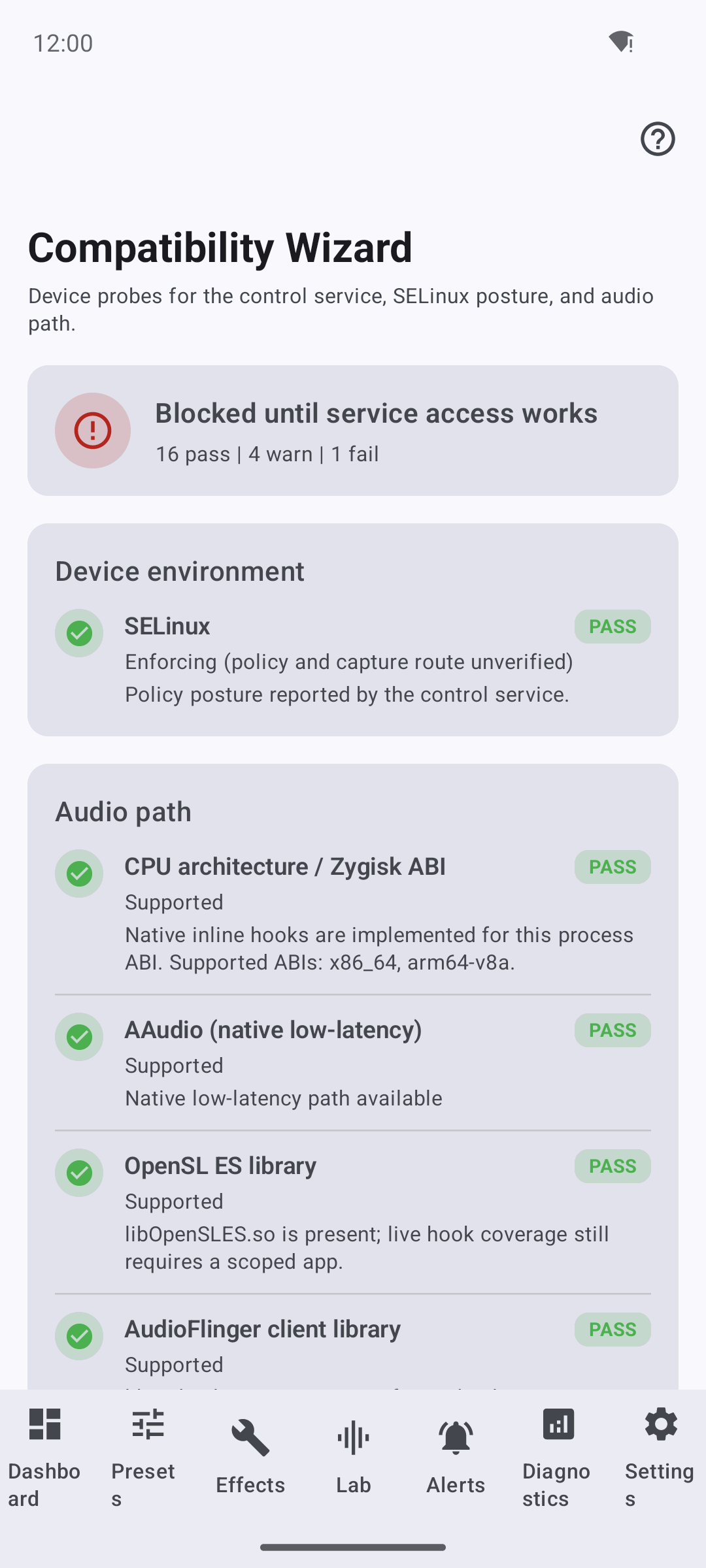
whether common native audio libraries (
libOpenSLES.so,libaudioclient.so,libtinyalsa.so) are present. These checks help identify obvious install and hardware mismatches, but they do not prove live AAudio, OpenSL ES, tinyalsa, or LSPosed processing.
- Device-gated: which combinations work is inherently a per-device matrix and is not characterized on hardware in this project.
5. Policy delivery is authenticated and transport-specific
The old profile-sync channel was a filesystem AF_UNIX socket where each hooked process
tried to bind /data/local/tmp/echidna_profiles.sock; only the last binder received
profile pushes. That single-holder limitation is now removed.
Current builds publish one strict v2 policy with a monotonic generation, explicit default profile,
whitelist, captureOwners, bindings, and complete control state. Zygisk uses authenticated,
UID-scoped frames over the service-owned abstract AF_UNIX socket echidna_profiles. LSPosed does
not use that socket: it binds an explicit read-only Binder provider, which authenticates the caller
UID and claimed process and returns only the exact/base scoped view.
Remaining caveats:
- Device-gated transport reachability: SELinux/OEM policy can still block the native socket, exported Binder bind/call, or telemetry mapping. Failure remains fail-closed.
- One capture owner per process: policy assigns
zygiskorlsposed; consumers require their own owner. Do not try to make both stacks own the same process. - Late/restarted publisher: native processing is revoked on disconnect and reconnects with bounded backoff. LSPosed fails closed and rebinds. Neither uses stale policy as admission proof.
6. armeabi-v7a (32-bit ARM) direct hooking is host-proven, on-device device-gated
Echidna's inline hooking is ABI-specific:
| ABI | Hooking status |
|---|---|
| arm64-v8a (aarch64) | Primary, fully implemented. |
| x86_64 | Implemented (absolute-jump patch + relocating trampoline with a fail-closed length decoder); host harness verified. The older rooted AudioRecord slice predates the current route contract. |
| armeabi-v7a (32-bit ARM / Thumb-2) | Relocator implemented and host-verified; on-device execution device-gated. A real ARM32/Thumb-2 prologue relocator now backs the direct inline-symbol routes (AAudio, OpenSL ES, tinyalsa, native AudioRecord, libc-read); the armv7 libechidna.so links under the NDK and the relocation harness passes on the host. The orchestrator attempts installation and the relocator fails closed per function on any prologue it cannot provably relocate (armv7_inline_relocation_host_proven_on_device_gated); on-hardware install/execution stays device-gated. |
Why on-device armv7 stays gated even though the relocator now exists: correct ARM/Thumb-2
relocation must handle variable-length (2/4-byte) Thumb encoding, IT-block hazards (patching
mid-IT-block corrupts execution), ARM/Thumb interworking on the low pointer bit, and PC-relative
prologue relocation. The relocator now implements this and is proven on the host, but the failure
mode of any missed case is a crash inside a system audio process, so on-hardware execution is
withheld until it is proven on a real armv7 device.
Zygisk's PLT API is not a safe late-load replacement. The bundled API v3 contract says API
functions stop working after postAppSpecialize; its Magisk v25.2 implementation registers with
xhook, refreshes the ELFs currently loaded in memory, and then clears the registration set.
Current Magisk retains the same one-shot property: the compatibility path scans current maps at
commit and clears its registrations. Echidna intentionally waits for authenticated process policy
after specialization, when the API is no longer available and app-native caller libraries can
still load later. It therefore cannot provide complete, target-scoped PLT coverage without adding
an unsafe loader hook.
Primary-source references: Magisk v25.2
api.hpp lines 162–220
and
hook.cpp lines 306–312,
plus the current compatibility implementation
module.cpp lines 164–220.
Since arm64 is the locked primary target and a complete PLT transaction still cannot be validated safely, armv7 relies on the inline relocator; it is host-proven but its on-hardware install/execution is device-gated rather than claimed at parity with arm64. This does not change the LSPosed Java/JNI route or the official legacy input preprocessor, which use different attachment boundaries and retain their existing policy and device gates.
The 64-bit path (arm64-v8a) covers essentially all current mainstream devices, so in practice this affects only older/32-bit hardware.
The app now reports CPU/ABI support directly in Compatibility and Diagnostics. A supported
module ABI does not always mean active hooks are enabled: arm64-v8a and x86_64 report native
hook support, while armeabi-v7a reports that its direct inline-symbol routes are host-proven but
device-gated for on-hardware execution.
7. What runs today vs. what needs hardware
To keep expectations honest:
| Capability | Status |
|---|---|
| Build (signed APKs, 12 native targets, 9 release-delivery artifacts, Magisk zip) | Verified on a full toolchain |
| Companion app: install, launch, screen navigation, in-app service bind | Verified on an unrooted emulator (crash-free) |
Native processBlock |
Verified on rooted Android 13/14 emulators |
Historical native AudioRecord.read slice |
Passed before current route redesign; not reachability proof |
| AAudio/OpenSL/tinyalsa/LSPosed capture | Device-gated — not validated here |
| Legacy input preprocessor | Device-gated — packaging/registration and a default-off authorized LSPosed session manager exist for proven system/vendor HIDL configs; device load/enable/audio proof remains |
| Native AudioRecord/libc | Developer contract only — not a normal-flow route |
| Audio HAL / AudioFlinger transform | Unsupported injection boundary |
| SELinux interaction for supported routes | Device-gated — per-device |
| Multi-app simultaneous policy delivery | Implemented with scoped socket/Binder transports; live capture still device-gated |
| armv7 voice transformation | Device-gated — relocator host-proven, on-device execution unproven (item 6) |
See Verification for the full proven-vs-device-gated matrix and a reproduce-on-hardware procedure.
Related reading
- Why It's Hard — the engineering reasons these constraints exist.
- Comparison — how these constraints compare to rootless/desktop alternatives.
- Architecture — the components and hook order these limits apply to.
- Verification — what is proven vs. needs a rooted device.